The Asia Healthcare Growth Playbook: Why Cross-Border Structuring Matters More Than Ever
Building in Asia healthcare? Jump to how to reach us →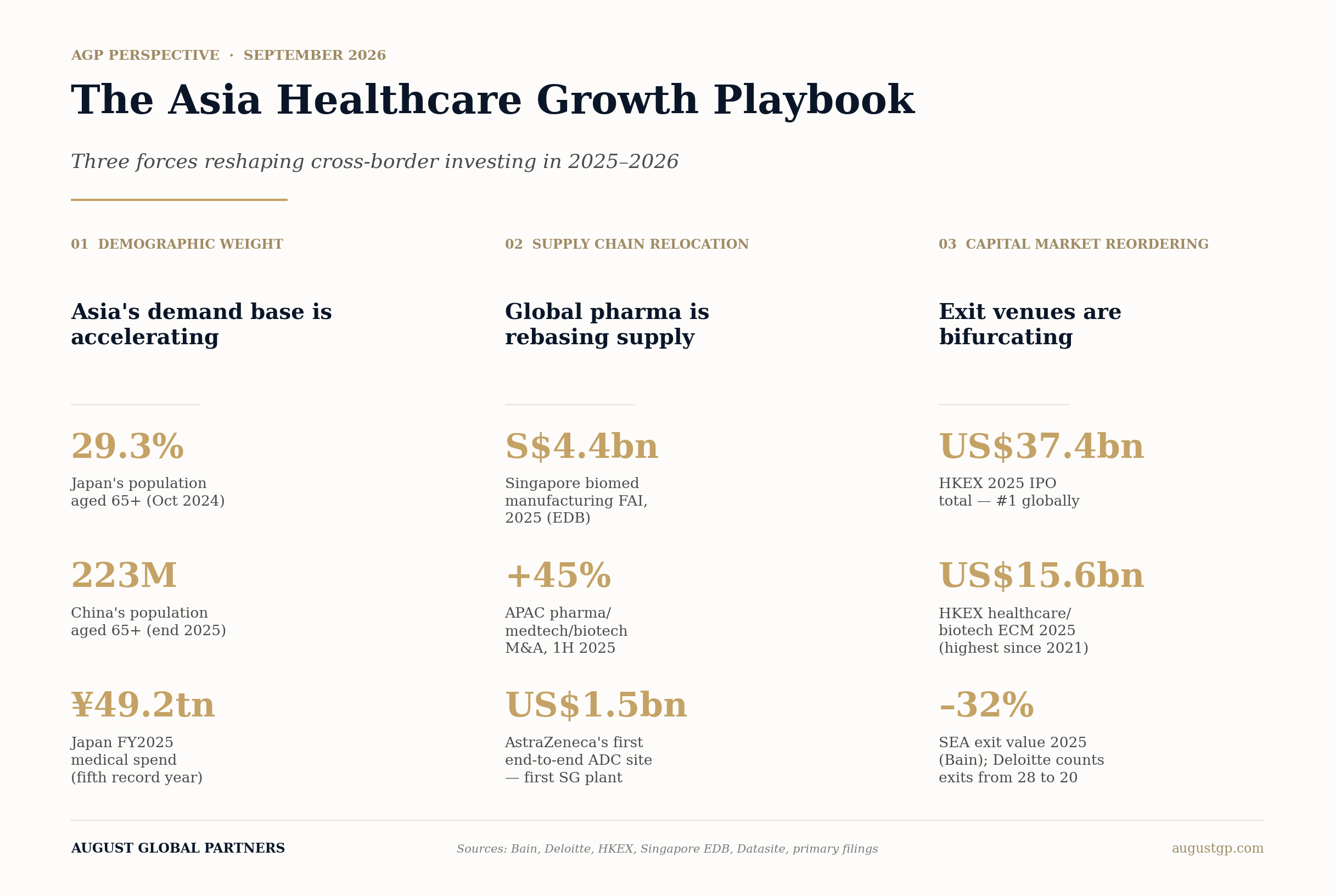
Two facts should reframe how investors think about Asia healthcare.
The first: in 2025, private equity deployed a record ~US$191 billion into global healthcare, and Asia-Pacific healthcare PE deal value ran more than 30% above its 2021 peak — a record year for the region even as Southeast Asia's all-sector PE dry powder fell over two years from US$32.1 billion to US$21.1 billion and SEA exits dropped from 28 to 20 deals in a single year.
The second: in April 2026, the United States proclaimed a 100% Section 232 tariff on patented pharmaceutical products — with duties phased in 120 days for larger companies and 180 days for smaller ones — with a preferential 15% rate for product from the EU, Japan, Korea, Switzerland, and Liechtenstein, and a 0% pathway (through January 2029) for companies that combine most-favored-nation pricing agreements with HHS and onshoring commitments with Commerce. Four months earlier, the BIOSECURE Act became law as Section 851 of the FY2026 NDAA, restricting US federal contracts, grants, and loans involving biotechnology equipment or services from designated Chinese biotechnology companies of concern — with the full designation list due by 18 December 2026.
Both facts point to the same conclusion. The dispersion of returns in Asia healthcare growth investing is widening, and the difference between the top and bottom quartile will not be who picked the right sub-sector. It will be who understood how to structure deals across jurisdictions when the ground under those jurisdictions was moving.
The demographic base case
Start with what everyone already knows, because it is the base of the pyramid. Japan's population aged 65 and over reached 29.3% in October 2024; its FY2025 national medical expenses reached a record ¥49.2 trillion, having risen for the fifth consecutive year. South Korea crossed the super-aged threshold in 2024; its per-capita public health spending is projected by the OECD to grow at over 3.5% a year through 2045 — well above the OECD average of 2.6%, and among the fastest in the group. China now has 223 million people aged 65 and over — a demographic weight without historical precedent in emerging markets.
Singapore joined the super-aged group in 2026, and the government has committed to lifting its health budget from about S$22.5 billion this year to S$30 billion by 2030 — from 2.7% to 3.5% of GDP.
Demographics create demand. The interesting question is who supplies it, and from where.
Supply chain relocation: from optionality to necessity
For a decade, the "China-plus-one" thesis in healthcare was optional. Global pharmaceutical and medical technology companies operated a China base, added Southeast Asian capacity when tax incentives aligned, and treated the diversification as a hedge rather than a plan.
That is no longer true. Datasite's read of first-half 2025 M&A activity in Asia-Pacific pharmaceutical, medical, and biotech deals — which rose 45% to US$30 billion — attributes the shift to a specific driver: "global pharma and biotech firms are reducing reliance on Chinese manufacturing in response to the US Biosecure Act and geopolitical pressures, driving capex into India, Southeast Asia, and Japan."
The evidence in Singapore alone tells the story. Singapore EDB reported that biomedical manufacturing fixed-asset investment reached S$4.4 billion in 2025, making biomedical the second-largest FAI industry in the country behind electronics. Individual announcements confirm the direction: AstraZeneca's US$1.5 billion greenfield antibody-drug-conjugate plant — its first-ever manufacturing presence in Singapore, targeted for operational readiness by 2029. Sanofi's €558 million (US$590 million) modular vaccine and biologics facility, described as the first modular manufacturing facility in the country. AbbVie's US$223 million expansion of its Tuas Biomedical Park site. Thermo Fisher's tri-hub Bioprocess Design Center network linking Singapore, Incheon, and Hyderabad.
Then the tariff. Section 232 makes the calculation explicit: a 100% headline tariff on patented pharmaceutical products, with a 15% rate for product from the EU, Japan, Korea, Switzerland, and Liechtenstein; an initial 10% rate for the UK under the December 2025 agreement in principle, reduced to 0% effective 31 July 2026 upon implementation of the US-UK pharmaceutical pricing agreement; a 20% rate for companies that sign onshoring agreements with the US Department of Commerce; and a 0% rate through 20 January 2029 for companies that combine most-favored-nation pricing agreements with HHS and onshoring commitments with Commerce. Duties phase in over 120 days for larger companies and 180 days for smaller ones. Generics and biosimilars are not tariffed at this time, subject to review in one year. Notably, Singapore and other Southeast Asian production sites are not named in any preferential band. But for global pharma companies, the tariff transforms the geographic question from "where is cheapest?" to "where is safest?" — and safety, in this environment, means production redundancy across two or three jurisdictions with contractually different exposure profiles.
The result is that the pick-and-shovel opportunity in Asia healthcare — contract manufacturers, fill-and-finish specialists, clinical trial infrastructure, cold chain, cross-border regulatory services — has moved from a growth story to a necessity story. And necessity, historically, produces different investment outcomes than growth.
Capital markets reordering
The exit environment is bifurcating in ways that matter for entry decisions.
Hong Kong has re-emerged as the dominant Asian venue for healthcare listings. HKEX raised US$37.4 billion across 119 IPOs in 2025, returning to the top of the global rankings, with healthcare and biotech equity capital markets issuance of US$15.6 billion — the highest since 2021. The 2025 IPO aftermarket for HK deals of US$100 million or more delivered 23.8% one-day and 30.7% one-month gains — the best performance in nearly two decades. Momentum extended into 2026: KPMG counts HK$209.9 billion raised across 85 new listings in the first half, the strongest first-half result in five years.
India has come alive at the top end. Manipal Health's US$960 million IPO, which began trading in August 2026, priced at 84.65x fiscal-year 2026 earnings — a valuation that reflects the scarcity value of large-cap listed Indian hospital assets. Bain Capital's ~US$3.3–3.4 billion take-private of Mitsubishi Tanabe Pharma, announced in February 2025, signalled that regulatory pressure on Japanese corporates to enhance shareholder value is now producing carve-out opportunities of a scale that was rare a decade ago.
Southeast Asia is the outlier. Even as APAC exit value rose more than 20% in 2025, Bain reports SEA exit value fell 32%, while Deloitte counts the SEA exit deal number falling from 28 to 20 in a single year, with trade sales and secondary buyouts accounting for 74% of the 2025 exit channel mix. Bain's Southeast Asia PE lead Tom Kidd was direct about what this means: "Capital is concentrating in fewer deals, and investors are more selective than at any point in recent years, with a clear focus on assets that can deliver value through execution."
For a growth-stage healthcare investor operating across this landscape, the implication is not "avoid Southeast Asia." It is that SEA-primary deals require exit optionality designed at entry — with realistic paths through Hong Kong, US, or Indian listings, secondary sales to strategic buyers who value the Asia presence, or structured continuation vehicles that convert traditional exit constraints into liquidity events. Structured deals — continuation vehicles, secondaries, GP-led liquidity — are no longer niche. They are how mature portfolios return capital in constrained markets.
What this means for growth-stage investing
Three capabilities separate the growth-stage investors likely to prosper this decade in Asia healthcare from those who will find themselves stuck in a slower cycle:
Cross-border structuring. A portfolio company headquartered in Singapore with clinical operations in Vietnam and commercial expansion into Korea now sits inside three different tariff regimes, two different biosecurity exposures, and two different FDA data-acceptance postures. Structuring the holding company, IP domicile, and cash-flow routes to preserve optionality across all of these is now foundational — not an accountant's afterthought.
Regulatory literacy across three or four jurisdictions. The US Select Committee on China's letter to the FDA, asking the agency to decline China-generated clinical trial data for IND, NDA, and BLA applications unless an in-person site audit has been conducted within the prior twelve months, is a signal not a conclusion — but it is a signal that reshapes deal diligence. An Asia healthcare growth investor now needs working fluency in FDA, NMPA, EMA, and at least one ASEAN health authority. Firms without that fluency will overpay for optionality they cannot actually execute.
Exit optionality designed at entry. With HKEX operating well, India priced richly, and SEA exit-constrained, the mistake is to assume a single default exit route at investment. The best growth-stage deals in Asia healthcare over the next five years will be structured with two or three plausible exit paths from day one — including secondaries, continuation vehicles, and cross-border strategic sales — and will be priced against the weighted probability of each, not the theoretical maximum of the best case.
This is a different skill set from the "specialist single-market operator" model that defined the last decade of Asia growth investing. It is closer to the discipline of exit-oriented mid-market PE in Western markets, adapted to a region where the regulatory ground moves faster and the exit channels rotate.
The playbook
The Asia healthcare opportunity is not passive. It requires investors who have done cross-border deals, sat on the operating side of clinical or commercial infrastructure at some point in their careers, and lived through more than one exit cycle. The demographics create the demand; the geopolitics of 2025-2026 have made the supply-side relocation structural rather than optional; the capital markets have reordered so that exit design is now a discipline, not a residual.
The playbook for the next decade of Asia healthcare growth investing will be written by cross-border specialists, not generalists.
If you're building in Asia healthcare, we'd like to hear from you.
August Global Partners writes growth-stage cheques up to US$20M into late-stage clinical (Phase 2b+), post-approval therapeutics, post-CE/FDA-clearance medtech, and post-revenue healthcare services or manufacturing — anywhere in the world, with material Asia exposure. We lead, co-lead, or structure secondaries and continuation vehicles.
Every pitch is read by a partner. We aim to respond within 10 business days.
Dr Basil Lui is Founding Partner and CEO of August Global Partners, a Singapore-headquartered growth-oriented fund management company investing across healthcare innovation and advanced manufacturing.
Views expressed are personal and do not constitute investment advice.